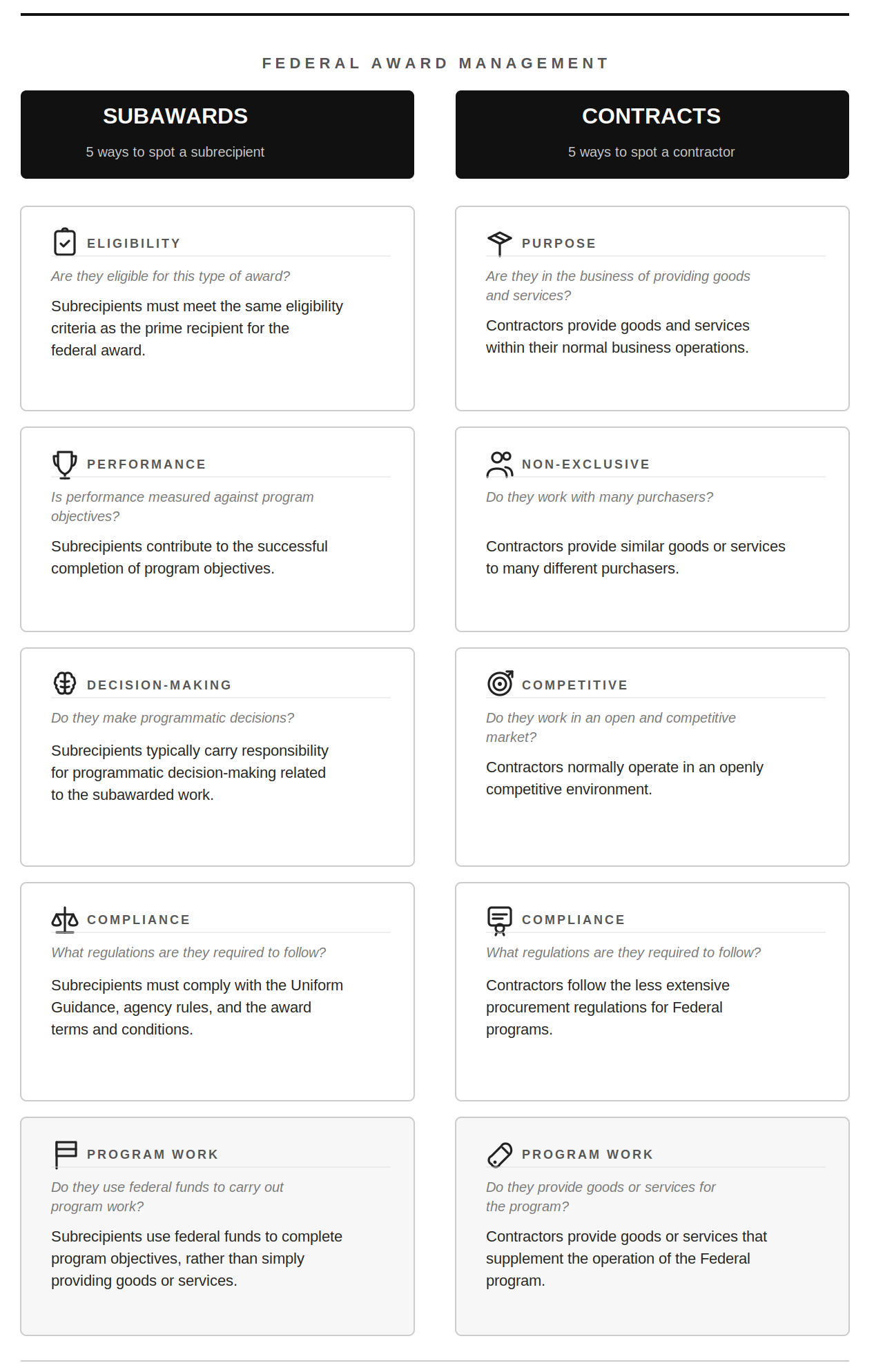
Deciding whether a partner is a subrecipient or a contractor is one of the most common classification calls in federal grants work, and it carries real consequences. The difference comes down to role, not organization type. Subrecipients help carry out the program itself, while contractors simply provide goods or services, and that distinction shapes your entire oversight and compliance approach. Document your reasoning clearly at the start and you'll save yourself a lot of trouble down the road.
At some point in almost every federal award, you will need to decide whether a partner is a subrecipient or a contractor. It sounds like a simple classification, but it carries real implications.
A subrecipient is helping carry out the program itself. They have a role in delivering the objectives of the award and are measured against those outcomes. A contractor, on the other hand, is providing goods or services as part of normal business operations.
The distinction is not about the type of organization. It is about the role they are playing in the project.
Once that classification is made, it determines how the relationship is managed. If the entity is a subrecipient, you are responsible for monitoring their performance, assessing risk, and reviewing both financial and programmatic reporting. That comes with a higher level of oversight.
If the entity is a contractor, your focus shifts to procurement requirements and contract management. The compliance expectations are different, and so is your role.
When the classification is off, the oversight is usually off too, which is why this decision tends to come up during audits.
One of the easiest ways to avoid issues later is to document your decision clearly at the start. Walk through the characteristics of the relationship and note why it fits one category over the other. Keep that documentation with your award records, and revisit it if the scope of work changes over time.
This does not need to be complicated. What matters is that the reasoning is clear and consistent. That way, if someone asks how the determination was made, your team can answer without having to go back and piece it together.
The strongest approach is to build a simple, repeatable process that your team can use consistently.
Start by reviewing expenses regularly instead of waiting until reporting deadlines. When something is not clearly straightforward, take a moment to document why the cost is necessary and how it supports the award. That one step makes a big difference later if questions come up. It also helps to align program and finance teams on how these decisions are made.
When everyone is working from the same understanding, there is less guesswork and fewer surprises. Allowability is not just about compliance. It is about making sure your decisions are clear, supported, and easy to explain.