What Are Modified Total Direct Costs (MTDC) and How Do They Work in Federal Grants?
May 5
/
Rachel Werner
If you have ever looked at your federal grant budget and wondered why your indirect costs do not match the total award amount, you’re not alone. That question almost always leads back to Modified Total Direct Costs, or MTDC.
MTDC is the base used to calculate indirect costs for many federal awards. Instead of applying your indirect cost rate to every dollar in your budget, the rate is applied to a specific portion of your direct costs. That means your total award is not the number driving your indirect cost recovery. Your MTDC base is.
Once you understand that shift, things start to click. Your indirect costs are not lower because of an error; instead, they’re lower because the base they are applied to is smaller by design.
MTDC is the base used to calculate indirect costs for many federal awards. Instead of applying your indirect cost rate to every dollar in your budget, the rate is applied to a specific portion of your direct costs. That means your total award is not the number driving your indirect cost recovery. Your MTDC base is.
Once you understand that shift, things start to click. Your indirect costs are not lower because of an error; instead, they’re lower because the base they are applied to is smaller by design.
What costs are included and excluded in Modified Total Direct Costs?
MTDC focuses on the core costs that support the day to day work of a program. This usually includes salaries, fringe benefits, travel, supplies, and services. These are the costs most directly tied to carrying out the work of the award.
At the same time, certain costs are intentionally excluded. Equipment, capital expenditures, participant support costs, and tuition remission are not part of the MTDC base. These are treated differently because they are not considered part of the ongoing operational structure that indirect costs support.
Subawards are where things tend to get confusing. Only the first $50,000 of each subaward is included in MTDC. Anything above that amount is excluded. If you’re working with multiple subrecipients, that one detail can significantly change your calculation.
At the same time, certain costs are intentionally excluded. Equipment, capital expenditures, participant support costs, and tuition remission are not part of the MTDC base. These are treated differently because they are not considered part of the ongoing operational structure that indirect costs support.
Subawards are where things tend to get confusing. Only the first $50,000 of each subaward is included in MTDC. Anything above that amount is excluded. If you’re working with multiple subrecipients, that one detail can significantly change your calculation.
How do you calculate MTDC correctly and avoid common mistakes?
MTDC issues usually are not about complicated math. They come from small missteps that build over time. A common example is applying the indirect cost rate to total project costs instead of the MTDC base. Another is forgetting to exclude the portion of each subaward over $50,000. Equipment is also frequently misclassified, which quietly throws off the calculation.
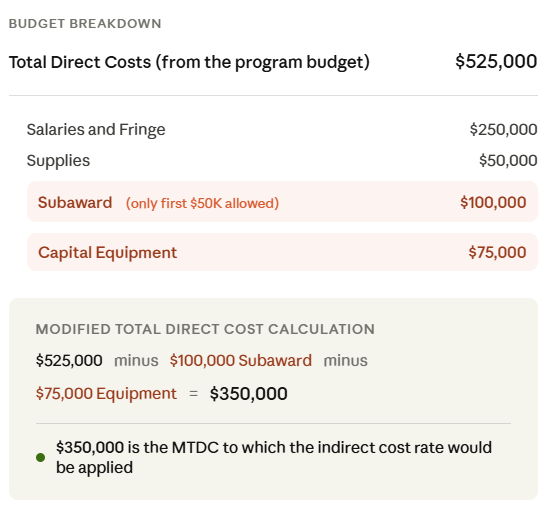
The easiest way to stay on track is to walk through your budget early.
Start by identifying which costs belong in MTDC and which do not. Then take a closer look at subawards and confirm only the allowable portion is included.
From there, apply your indirect cost rate and compare it to what you are actually charging.If something feels off, it usually is worth a second look.
Catching it now is a lot easier than trying to explain it later during reporting or closeout.

Start by identifying which costs belong in MTDC and which do not. Then take a closer look at subawards and confirm only the allowable portion is included.
From there, apply your indirect cost rate and compare it to what you are actually charging.If something feels off, it usually is worth a second look.
Catching it now is a lot easier than trying to explain it later during reporting or closeout.

Copyright © 2024 MyFedTrainer | All Rights Reserved
Martha A Moore, MPA, DTM, CNAP, has been working in the accounting industry for over 35 years. Over that time, she has worked in the Grants Management area for 20 years. She has recently received the Certified Nonprofit Accounting Professional (CNAP) credentials. Martha’s expertise in grants management field is in the post-award/closing/audit areas, while serving as an advisor to preaward budgeting and program narrative. Thanks to her many years in the accounting/grants management industry, Martha has the ability to zoom out and holistically see the big picture and how external funding can be crafted for effective and efficient use. She believes in team approach with both finance and program team at the table to ensure a clear and comprehensive award application, with the end goal being grant awards. Martha also has extensive experience in subaward management from a university to a local nonprofit organization. Martha is a public speaker and trainer, thanks to her many years (20+) in Toastmasters International. She earned the highest designation, Distinguished Toastmaster, and puts those skills to use daily. Martha’s niche’ is the desire to see local nonprofits (BIPOC startups to mature nonprofits) succeed in securing funding to fulfill community gaps in partnership with the philanthropists, private sectors, local, state, and federal governments.
